
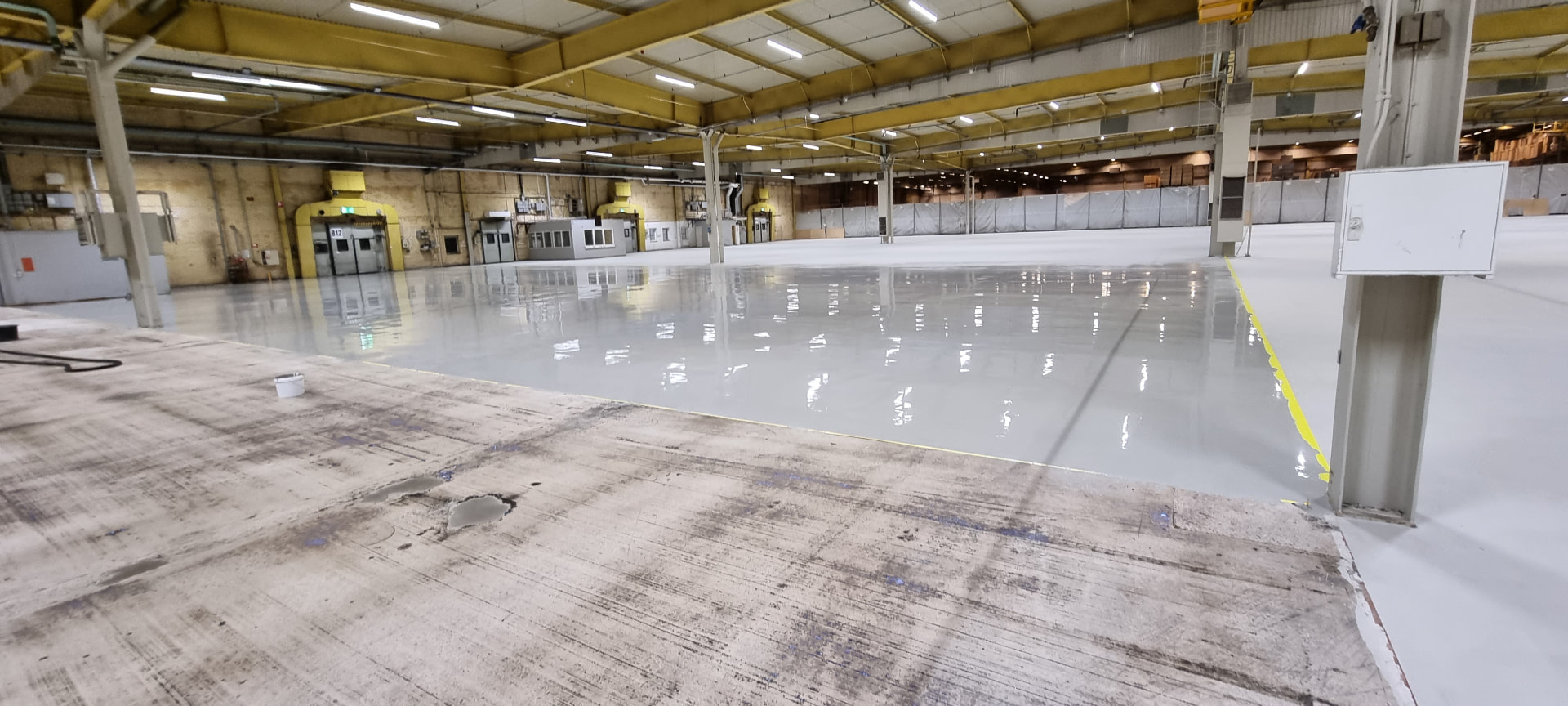
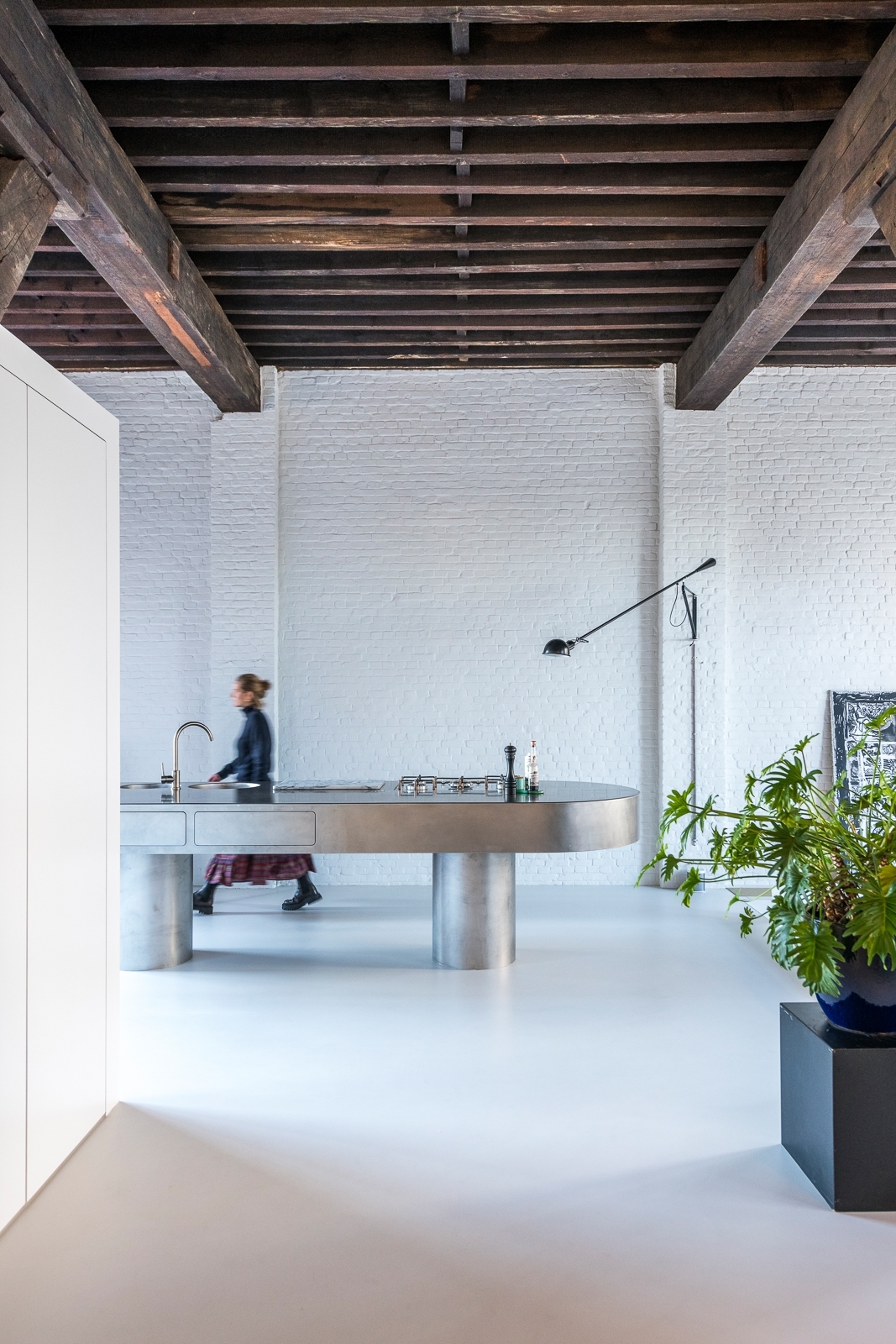
 Mineral flooring systems.
Silicate Systems is built on mineral chemistry, expressed across a range engineered for consistency. Applied over existing substrates, no demolition required.
Silicon dioxide activated from GGBS and fly ash.
Very low emission, licensed per product.
ISO 14025 / EN 15804, covering 11 products.
From 1mm to 70mm, depending on the system.
Moisture escapes rather than getting sealed in.
Full methodology on the proof hub.
Substrate to finish
On a sound substrate, three steps: prime, pour, protect. Repair and levelling only when the substrate needs it.
What are you starting from?
Design and commercial floors on concrete or screed
The standard build-up: prime, pour the finish, protect. Repair and levelling only when the substrate needs it.
Select a layer to view products and data sheets.
























This is what the contractors say.
“We can now enthusiastically offer our customers diffusion-open and waterproof coatings from ESS, which can solve problems such as moisture and water damage. This is especially relevant in Denmark, where many projects are carried out below the water table. Furthermore, it is interesting to see a sustainable product of high quality in precisely these times, with an increasing green agenda.”
JTI Gulventreprise A/SFlooring contractor, Denmark “We are pleased to have worked together with ESS, as it was possible for us to solve a specific problem for our customer - namely that the subfloor had alkali-silica reactions in the concrete, which made a coating with epoxy impossible. Furthermore, we find it exciting to work with a sustainable alternative within the industry.”
Hewikut A/SFlooring contractor, Denmark “After we were introduced to Eco Silicate Systems' products, we believe that, if an environmentally friendly floor is desired, without hazard labeling and with low VOC emissions, then their products are exactly the right solution. Furthermore, if the need is a hard-wearing floor that is also diffusion-open, then ESS products are also our recommendation.”
Belægningsteknik A/SFlooring contractor, Denmark
Why
| Property | Silicate Systems | Other |
|---|---|---|
| Material class | Inorganic | Organic |
| Vapour permeability | Open | Closed |
| Moisture and ASR tolerance | Vapour-open, immune to osmotic blistering | Risk of osmotic delamination |
| Circular content | 90% | Typically 0% |
| Isocyanates | None | Present, REACH-classified |
| Thermal resistance | 700°C* | ~150°C |
| Chemical resistance | pH 3-14* | Narrower range for typical resin coatings |
| Drinking-water and pool approval | KTW, KSW, DVGW† | Not rated |
- * Eco Resist. Comparison figure for a typical resin-based system.
- † Eco Sil, Eco All In One.
FAQ
What is a silicate floor system?
A liquid-applied mineral floor built on a silicate binder — silicon dioxide, the same compound found in sand, glass, and quartz. It cures into an inorganic, vapour-permeable layer applied directly over an existing substrate.
What building-certification credits does it contribute to?
BREEAM, DGNB and LEED contribution is documented per project. The credits depend on the specific systems in the build-up.
Is the floor seamless, or are there joints?
The systems are laid as a continuous, jointless surface, coved into wall junctions where required — no expansion joints breaking up the floor.
What colours and finishes are available?
Most systems are available in their raw, unpigmented colour or pigmented with RAL matching. Eco Terrazzo takes its colour from the aggregate mix — marble, glass, or stone — rather than pigment.
How soon can the floor be used?
The rapid-cure systems (Eco Rapid, Eco Rapid Indu, Eco Screed) are walkable after 4 hours at 20 °C, take light load after 1 day, and are fully loadable after 4 days indoors and 7 days outdoors. Cure times vary by product — check the technical data sheet for specifics.
What is the minimum application temperature?
From +2 °C to +10 °C minimum, depending on the system. Check the technical data sheet for each product's application conditions.
What certification and documentation is available?
EMICODE EC1PLUS across most of the range — Eco Topcoat Mono carries EC2. Eco Sil and Eco Flex All In One are also VOC- and APEO-free. EPD verified — two EPDs under ISO 14025 / EN 15804 cover the dry mortar and primer/coating families. Data sheets and declarations of performance are published per product on the systems pages.
Can it be applied over an existing floor?
Yes. In renovation, the lower limit is 2 mm, so the old floor usually stays in place — no demolition required. The substrate needs to reach a pull-off strength of at least 1.5 N/mm², stated as a condition on the data sheets.
Can silicate systems be applied over damp slabs or concrete with alkali-silica reaction (ASR)?
Yes. Because the binder is inorganic and vapour-permeable, rising damp diffuses through without building the osmotic pressure that blisters synthetic resins such as epoxy and polyurethane. The mineral silicate chemistry is also unaffected by reactive aggregates, so it does not delaminate over concrete with alkali-silica reaction (ASR).
How does it compare with resin systems like epoxy or polyurethane?
The binder is inorganic rather than organic, contains no isocyanates, and stays vapour-permeable rather than sealed. Eco Resist withstands 700°C intermittently against roughly 150°C for a typical resin-based system.
Is it suitable for drinking water and pools?
Eco Sil carries KTW drinking-water approval and KSW pool approval. Eco All In One carries DVGW W270 and W347.
How do silicate systems compare to micro cement and micro topping?
Micro cement and micro topping are thin cement-based coatings, typically 2–3 mm. Silicate systems are liquid-applied mineral floors built on a silicate binder — inorganic, vapour-permeable, and available from 1 mm to 70 mm. The binder is mineral, not a cement film.
Is this a stucco or plaster system?
No. Stucco and plaster are wall finishes. Silicate systems are liquid-applied floors and waterproofing membranes — though Eco Wall and Eco Hydro Sil can be applied to vertical surfaces as mineral coatings.
Can a silicate floor replace a mortar screed or a grezzo base?
Eco SL Mortar and Eco Screed are silicate-bonded mortar systems that work as a levelling layer or wearing surface from 5 mm to 70 mm. Unlike a grezzo — a rough, unfinished base — a silicate floor is a finished, load-bearing surface.